



Fela Kuti Enters the Grammy Pantheon: The Crowning of an Unbowed Africa
Fela Kuti makes history: in 2026 he becomes the first African honoured with a Grammy for his lifetime achievement. Discover the crowning of the “Black President”


The Crowning of Abami Eda: Fela Kuti and the Apotheosis of Afrobeat at the 2026 Grammy Awards
On 31 January 2026 in Los Angeles, the Recording Academy posthumously presented the Lifetime Achievement Award to Olufela Olusegun Oludotun Ransome-Kuti, the immortal Fela Kuti. Almost thirty years after his passing into the beyond in 1997, the man his followers called the “Black President” became the first African artist in history to receive this career honour, joining a pantheon of legends that, in the same year, included icons such as Whitney Houston, Carlos Santana, Chaka Khan, Paul Simon and Cher.
This recognition is not simply a tribute to a monumental catalogue of more than fifty albums; it marks a pivotal moment in the West’s institutional validation of African culture. For Africa and its diaspora, the award redresses a historical dissonance. Although Fela Kuti held a world record for the number of albums recorded as a solo artist, he was never nominated for a Grammy in his lifetime. The 2026 event therefore resonates as a necessary reconciliation between an awards system long centred on the North Atlantic and a radical sound, born in the very depths of West Africa, which today defines a major part of the canon of global Black music.
A Historic Consecration: The Time for Recognition
The Recording Academy’s decision to honour Fela Kuti in 2026 is part of a profound transformation of the music industry. The award is not an isolated gesture but the culmination of African music’s rise on the global stage, symbolised by the introduction, in 2024, of the “Best African Music Performance” category. The Lifetime Achievement Award is a specific honour, conferred by the Academy’s National Trustees on performers who have made creative contributions of outstanding artistic significance to the field of recording during their lifetime.
The importance of the moment is underlined by the stature of the other members of the class of 2026. By placing Fela Kuti alongside giants of pop, rock and soul, the Grammy Awards acknowledge that Afrobeat is not a niche genre but a global cultural architecture whose influence rivals that of Bob Marley or James Brown. The honour follows another major milestone: in June 2025, the legendary album Zombie, released in 1976, was inducted into the Grammy Hall of Fame, a first for a Nigerian album.

This double recognition in 2025 and 2026 shows that the global industry has at last grasped the full measure of Abami Eda’s legacy. For music critics, it marks the end of an era in which Fela was seen as a “cult” legend or a subversive activist, and his elevation to a canonised monument of world heritage.
The Legacy of Afrobeat: A Sonic and Political Revolution
To understand the significance of this Grammy, we must go back to the origins of Afrobeat. Fela Kuti was not merely a musician; he was a sonic architect who fused his Nigerian roots with a formal musical education acquired at Trinity College of Music in London. Born in Abeokuta in 1938 into a family of the intellectual elite, the son of an Anglican minister and of Funmilayo Ransome-Kuti, a pioneer of feminism and the anti-colonial struggle, Fela grew up at a crossroads of cultures.
The year 1969 marked the great ideological turning point of his life. While touring the United States with his band Koola Lobitos, Fela met Sandra Izsadore, an activist close to the Black Panther Party. The encounter was an electric shock. Sandra introduced him to the writings of Malcolm X, Angela Davis and Frantz Fanon. Fela then realised that his music had to stop imitating Western standards and become a weapon of African liberation. Back in Nigeria, he changed his surname from Ransome-Kuti (which he considered colonial) to Anikulapo-Kuti, “he who carries death in his pouch”, and renamed his band Afrika 70.
Afrobeat, as he conceived it in the 1970s with his partner in crime, the legendary drummer Tony Allen, is a complex construction. It is an organic fusion of jazz, funk, Ghanaian highlife and traditional Yoruba rhythms. The sound is distinguished by powerful horn sections, hypnotic polyrhythms and tracks whose length defies every radio convention, often running beyond thirty or forty minutes.
The Kalakuta Republic: Resistance at the Heart of Chaos
The 2026 award also honours the man who refused to separate his art from his political commitment. Fela Kuti founded the Kalakuta Republic, a commune he declared independent of the Nigerian state, housing his studio, his family and his followers. This bastion of counterculture became the symbol of his head-on struggle against Nigeria’s corrupt military regimes.

The album Zombie, the centrepiece of his work, illustrates this confrontation. By comparing Nigerian soldiers to mindless automatons, Fela struck at the heart of the security apparatus. The repression was terrible: in 1977, nearly a thousand soldiers stormed Kalakuta, setting the buildings on fire, brutalising the residents and throwing Fela’s mother, Funmilayo, from a window; she would later die of her injuries. Far from breaking him, the tragedy strengthened his resolve, driving him to lay his mother’s coffin outside Dodan Barracks, the residence of General Olusegun Obasanjo, and to compose “Coffin for Head of State”.
His courage in the face of adversity, including repeated imprisonment, notably under the regime of Muhammadu Buhari in 1984, forged his status as martyr and prophet. Fela used music not only to entertain but to educate the masses through Pidgin English, making sure that his message of African sovereignty was understood from Senegal to Ethiopia.
The Kuti Dynasty: Guardians of an Undying Flame

At the Special Merit Awards ceremony, emotion ran high when Fela’s children, Femi, Yeni, Kunle and Shalewa, took to the stage to accept the trophy. For the family, the award is a major symbolic victory, albeit tinged with some bitterness at how long it took.
Femi Kuti, himself a Grammy nominee several times over during his career, stressed that the moment mattered not only for Nigeria but for the whole of Africa and for the worldwide struggle for justice. His sister Yeni voiced a feeling shared across the diaspora: “Better late than never.” She recalled that while Fela never sought the West’s approval in his lifetime, the award now anchors his message in the official archives of human history.
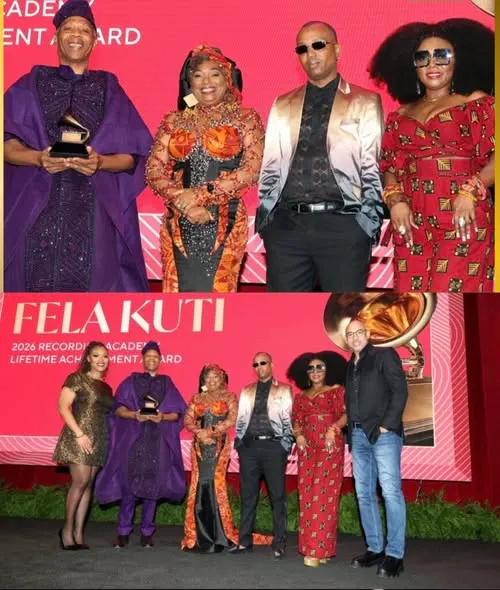
Fela’s grandson, Made Kuti, represents the third generation of this exceptional lineage. Trained, like his grandfather, at Trinity College, he sees this Grammy as a celebration of Fela’s many-sided talent, which he ranks alongside that of the greatest composers in history. He points out that Fela’s influence proves the richness of a music that broke the chains of commercial formats to impose its own rhythm on the world.
From Afrobeat to Afrobeats: An Undeniable Lineage
One of the Recording Academy’s main arguments for the award is Fela’s enduring influence on contemporary music. It is impossible to imagine the current global success of stars such as Burna Boy, Wizkid or Tyla without the foundations laid by Fela Kuti. Burna Boy, who won a Grammy in 2021, regularly cites Fela as his spiritual and artistic compass.
Musical analysis, however, requires a distinction between Afrobeat (singular), the political, orchestral genre created by Fela, and Afrobeats (plural), the modern pop fusion that dominates the charts today. While younger generations have sometimes watered down the political message in favour of a more commercial aesthetic, the 2026 award is a reminder that the movement draws its strength from a deeply militant root.

The 2026 ceremony bore witness to this vitality. South African singer Tyla won her second consecutive Grammy for “Best African Music Performance” with her single “Push 2 Start”. Accepting her award, she declared: “We are no longer just joining the conversation; we are leading it.” That confidence is the direct legacy of Fela’s audacity, who as early as the 1970s asserted the superiority of African cultural values over imported models.
The Institutional Irony: A Rebel in the Pantheon
There is a poignant irony in an organisation like the Recording Academy, a pillar of the Western music industry, honouring a man who spent his life fighting the cultural and economic hegemony of the West. Fela Kuti fiercely denounced the “colonial mentality” and the imperialism of multinationals. Some observers wonder: what would the “Black President” have made of this trophy?
For Rikki Stein, his long-time manager, who attended the ceremony, what matters most is transmission. The award ensures that Fela’s music and, above all, his social message will reach millions of young people around the globe who were not born in his lifetime. His catalogue of more than fifty albums is now seen as a library of resistance and African identity, open to a generation in search of historical truth.
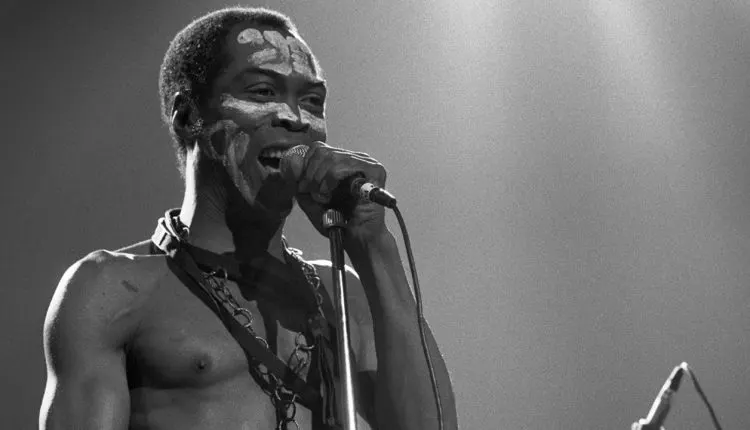
The often overlooked spiritual dimension of his work is also brought back into the light. Fela, who proclaimed himself Abami Eda (the Strange Being), advocated a return to ancestral spiritualities and to pure Pan-Africanism. By honouring the man, the Grammy Awards implicitly acknowledge the validity of his world view, long dismissed as radical or eccentric.
A Message for the Diaspora and the Future of the Continent
For the African diaspora, this Grammy sends a powerful signal. In a globalised world where identity is often a battlefield, Fela Kuti offers an unshakeable anchor. His 1969 journey to the United States and his contact with the civil rights movement prove that Black culture is a continuous circle of exchange and mutual reinforcement. Sandra Izsadore, the woman who awakened his political consciousness, stresses that Fela has become a musical prophet whose lyrics are more relevant today than when they were written.
That relevance shows in the unwavering support of fans across the decades. Felabration, the annual festival held in Lagos and around the world, continues to draw thousands of cultural pilgrims. The New Afrika Shrine, run by his children, has become a historic landmark where diplomats, heads of state and ordinary citizens meet, all united by the rhythm of Afrobeat.
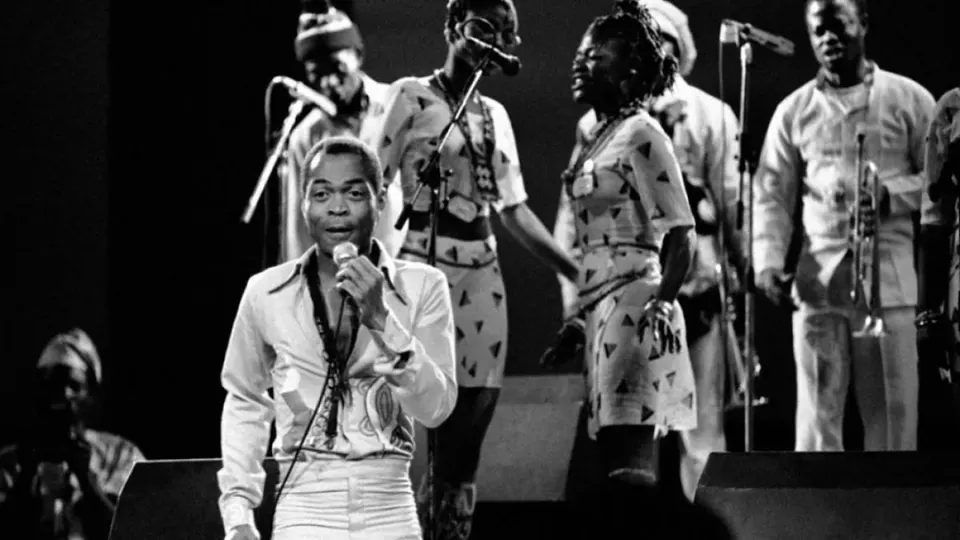
Nigerian President Bola Tinubu himself paid tribute to the artist, calling him the “king of Afrobeat” and a fearless voice of the people. Despite the violent conflicts that once pitted him against the Nigerian state, Fela is today recognised as the country’s greatest cultural ambassador, the man who turned the pain of repression into a symphony of freedom.
The Eternity of Rhythm and Truth
The Lifetime Achievement Award presented to Fela Kuti in 2026 is not the culmination of a career but the beginning of a new era for his message. By honouring the creator of Afrobeat, the Recording Academy concedes that the beating heart of modern music now lies in Africa. This award belongs to everyone who believes that art can change the world, as Yemisi Ransome-Kuti so aptly put it.

Fela Kuti’s legacy lies in his having proved that music is a weapon, a religion and a celebration. His influence on future generations ensures that the rhythm of Afrobeat will keep resonating for as long as there are injustices to denounce and identities to celebrate. The “Black President” has at last received his international investiture, reminding the world that while political regimes come and go, the truth carried by rhythm is immortal.
Pélagie BLEWUSSI